


Species Guide · Otso
Finland’s largest land predator — powerful, adaptable and remarkably elusive. Discover the complete natural history of the Brown Bear across Finland’s boreal forests.
Maximum male weight
Estimated population
Male home range
Typical wild lifespan
Short-distance speed
On this page
The Brown Bear (Ursus arctos) is Finland’s largest land predator and one of Europe’s most iconic mammals. Revered in Finnish folklore and admired by wildlife photographers, the species has become a symbol of the country’s vast wilderness.
Despite their size, Finnish Brown Bears are remarkably elusive. They live across enormous boreal forests, peatlands and wetlands, moving quietly in search of berries, insects and other seasonal foods. Their secretive nature means that most bears avoid people long before people realise they are nearby.
This guide explores the natural history of Finland’s Brown Bears — from anatomy, diet and behaviour to hibernation, reproduction, conservation and responsible wildlife watching.
Common name
Diet
Shoulder height
Home range
Mating season
Cubs born
Population
Animal family
Typical weight
Claws
Social life
Reproduction
Activity
Finnish status
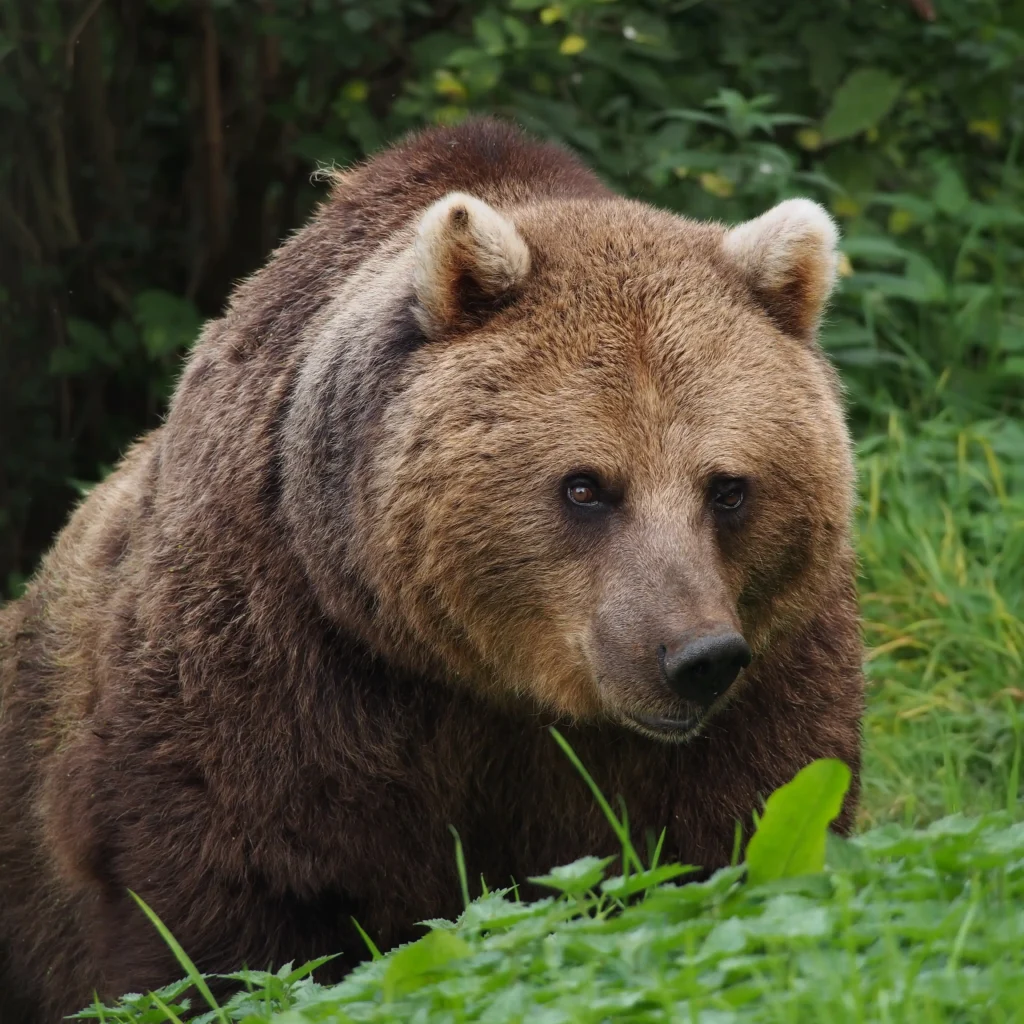
Finnish Brown Bears vary considerably in size and colour. Adult males, or boars, are typically much larger than females, or sows. Adult males commonly weigh 180–350 kg, while females usually weigh 90–180 kg.
Coat colours can range from dark chocolate brown and rich chestnut to cinnamon, blonde and almost black. Seasonal wear can also make a summer coat appear faded or patchy later in the year.
Brown Bears are built for strength rather than long-distance speed. Their broad chests, powerful forelimbs and prominent muscular shoulder hump help them dig dens, overturn rocks, tear apart rotten logs and move through difficult terrain.
Each foot has five toes with long, permanently extended claws that may exceed 10 centimetres. Adult front paw prints can measure more than 20 centimetres wide.
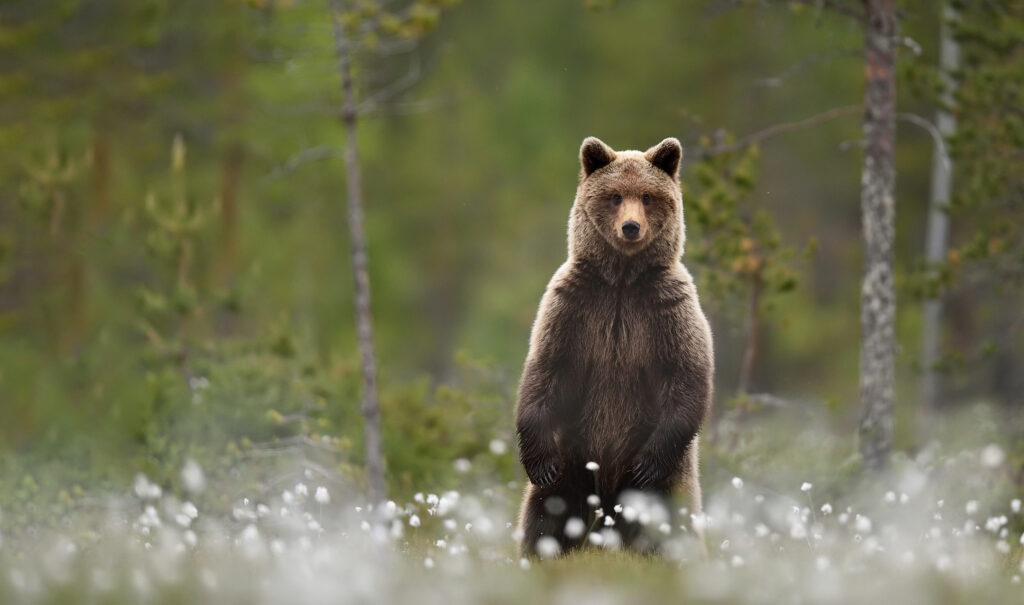
When standing on all fours, an adult Brown Bear is generally around one metre at the shoulder. Large males can exceed two metres when standing upright. Their muscular shoulders and broad forelimbs give them the powerful build needed for digging, climbing when young, and moving heavy objects.
Colour varies from dark chocolate and chestnut to cinnamon, blonde and almost black. Fresh summer coats can look glossy, while older coats may appear faded or patchy during moulting.
Brown Bears combine thick seasonal fur with substantial fat reserves to cope with Finland’s long winters. Their powerful shoulders support digging and excavation, while their claws help them uncover roots, insects and sheltered den sites.
They can also accelerate surprisingly quickly and reach speeds approaching 50 km/h over short distances, although they rarely need to do so around people.
If one sense defines the Brown Bear, it is smell. Its olfactory ability may be several thousand times more sensitive than that of humans, allowing it to detect food, other bears and potential danger long before a person becomes aware of the animal.
Hearing and vision are also effective supporting senses. Large mobile ears help bears locate subtle sounds, while their eyesight is capable of detecting movement over considerable distances.
A Brown Bear’s combination of smell, hearing, memory and physical strength makes it exceptionally well adapted to Finland’s enormous forests. Their spatial memory allows them to remember productive berry patches, ant nests and seasonal food sources across hundreds of square kilometres.
Brown Bears inhabit vast areas of Finland’s boreal forest, including spruce forests, peatlands and wetlands. Strong populations are associated with regions such as Kuhmo, Kainuu, North Karelia, Northern Savonia and eastern Lapland.
Many bears also move across the Finnish–Russian border, making ecological connectivity important for maintaining a healthy transboundary population and genetic diversity.
Home ranges vary with food availability, habitat quality, population density, sex and age. Female ranges may cover around 100–300 square kilometres, while dominant adult males can roam across 1,000 square kilometres or more.
Brown Bears are not truly territorial in the same way Wolves are. Their home ranges frequently overlap, allowing several bears to use the same forest at different times without constant conflict.
Bears often resolve disputes through body language, scent communication and subtle displays of dominance. Avoiding serious injuries makes evolutionary sense for animals that depend on their strength and mobility to find food and survive winter.
Brown Bears communicate primarily through scent rather than dramatic vocalisations. Rubbing against trees leaves chemical information that other bears can later read, including clues about sex, reproductive status, size and identity.
Brown Bears rub their necks, shoulders and feet against trees, leaving scent from specialised glands. These scent trees function like communal noticeboards, telling passing bears who has recently been in the area.
When bears vocalise, the sounds are usually subtle: huffing, snorting, woofing, low grunts, cub squeals and maternal calls. Loud roaring is generally associated with aggressive encounters or extreme stress.
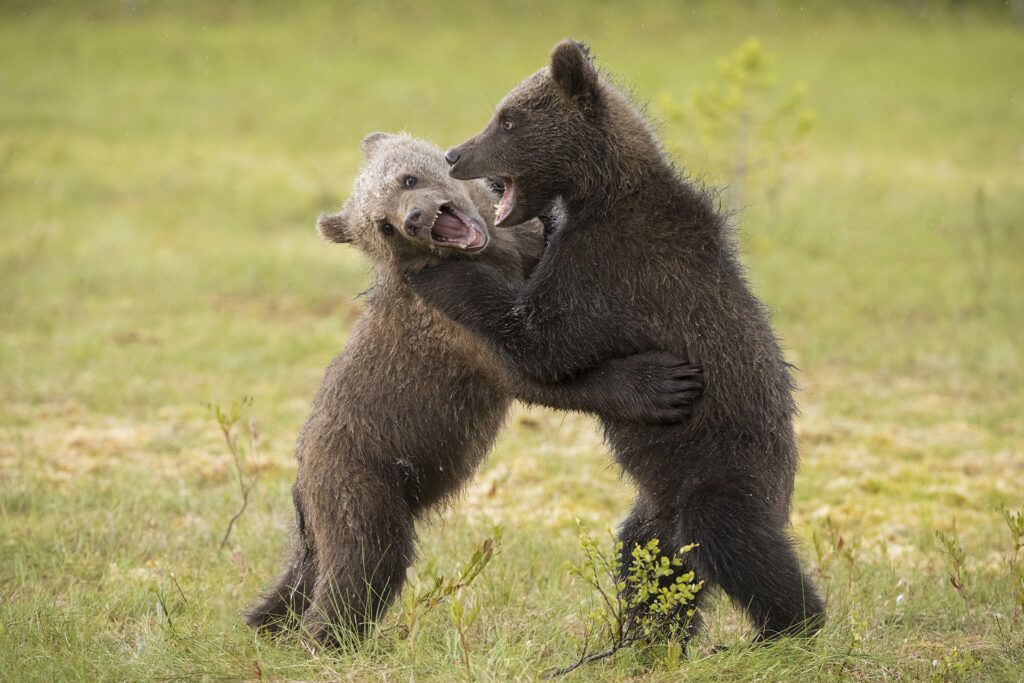
Body language and scent work together to reduce unnecessary conflict. Bears can use posture, movement and scent information to communicate without physical fighting.
Brown Bears mate during late spring and early summer, typically between May and July. One of their most remarkable reproductive adaptations is delayed implantation: the fertilised embryo remains suspended while the female feeds and builds fat reserves through summer and autumn.
Implantation occurs only after the female enters hibernation and has accumulated sufficient reserves. This strategy reduces the risk of raising cubs during years when food resources are inadequate.
Most cubs are born between January and early February while their mother is still inside her winter den. Newborns weigh only around 300–500 grams, are blind and almost hairless, and depend completely on their mother.
Exceptionally rich milk supports rapid growth through winter. By spring emergence, cubs typically weigh around 4–6 kilograms and are already able to follow their mother through the forest.
Cubs spend their first spring and summer learning almost entirely through observation and imitation. They learn to identify edible plants, find insects, cross streams, recognise danger, climb trees and respond to other bears.
Brown Bear cubs generally remain with their mother for around two and a half years before becoming independent. Adults are then predominantly solitary.
Brown Bears are opportunistic omnivores. Their diet changes with the seasons and is shaped by whatever food provides the greatest nutritional reward for the least energy.
Plant material dominates much of the annual diet, with berries becoming especially important during late summer and autumn as bears prepare for winter.
Spring foods: grasses, sedges, roots, insects & carrion
Early summer: cow parsley, angelica, fireweed & insects
Late summer: bilberries, lingonberries, crowberries & rowan
Autumn: berries, hazelnuts, oats & agricultural crops
Occasional food: carrion and young moose or reindeer calves
Ants and insect larvae
Roots and marsh vegetation
Other seasonally available foods
Large prey only occasionally
During late summer and autumn, Brown Bears enter hyperphagia — a period of extremely intensive feeding before hibernation. They may consume 20,000 calories or more per day, with berries providing a major share of that energy. By winter, many adults have increased body weight by 30–40%.
Bears use smell, memory and experience to locate productive feeding areas, including berry patches, ant nests and seasonal food sources.
During berry season they can spend more than half of their waking hours feeding, moving slowly through productive forest and stripping plants of fruit.
Powerful forelimbs and long claws allow bears to excavate ant nests, turn over rocks, tear apart rotten logs and uncover roots.
Although Brown Bears can kill large prey when circumstances demand it, large mammals form only a relatively small part of their overall diet.
The main objective of late-summer and autumn feeding is simple: accumulate enough fat to survive five to six months without eating.
As autumn progresses, Brown Bears withdraw into carefully selected winter dens. Hibernation is an energy-saving strategy that allows them to survive months when berries, plants and insects are unavailable beneath snow.
Adult males usually enter hibernation between late October and November, while pregnant females and females with cubs may den slightly earlier. Spring emergence typically occurs between late March and early May.
Brown Bears generally avoid people, and direct encounters remain surprisingly uncommon. Their extraordinary sense of smell allows them to detect human presence from considerable distances, so most bears leave the area long before anyone realises they are nearby.
If you unexpectedly see a bear, remain calm, do not run, speak calmly, slowly back away, never approach cubs and give the animal a clear escape route.
A peaceful encounter is the goal. Give the bear space and allow it to move away without being cornered or followed.
Brown Bear watching in Finland is usually done from specially designed wildlife hides in remote areas where bears regularly roam. The animals are free to come and go, while visitors remain quiet and still to minimise disturbance.
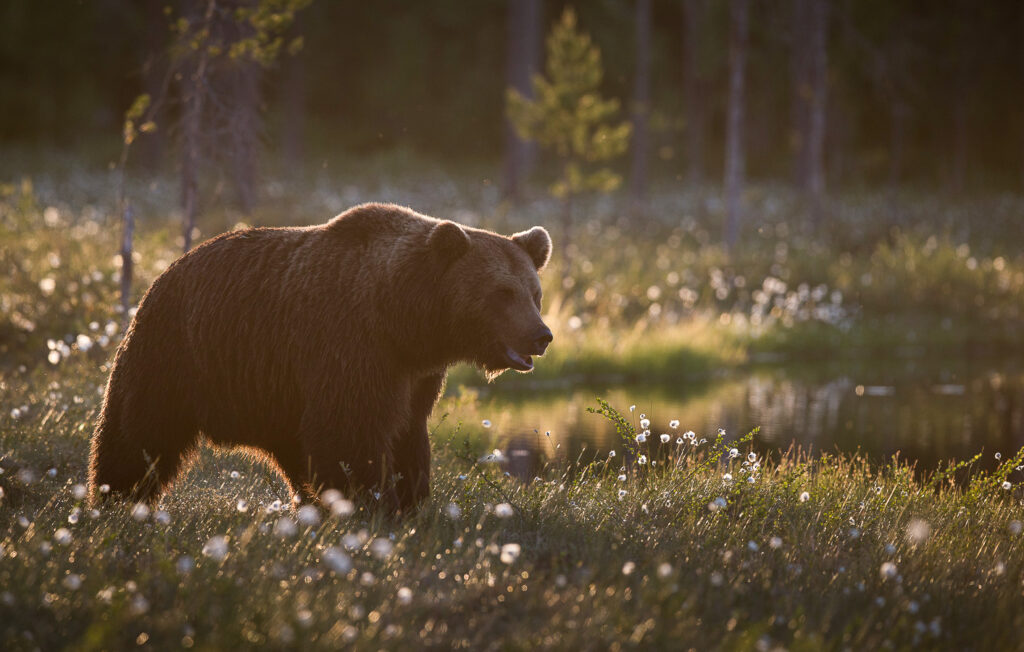
The watching season generally runs from April to October. Spring can bring snow and hungry emerging bears; summer offers long daylight and soft evening light; late summer and autumn often provide the finest combination of bear activity, hyperphagia and colourful forest scenery.
Brown Bear watching often takes place during the evening or overnight, when light levels are low. A camera with strong high-ISO performance, a suitable telephoto lens and a stable support can make a major difference. Staying quiet and avoiding strong fragrances also helps minimise disturbance.

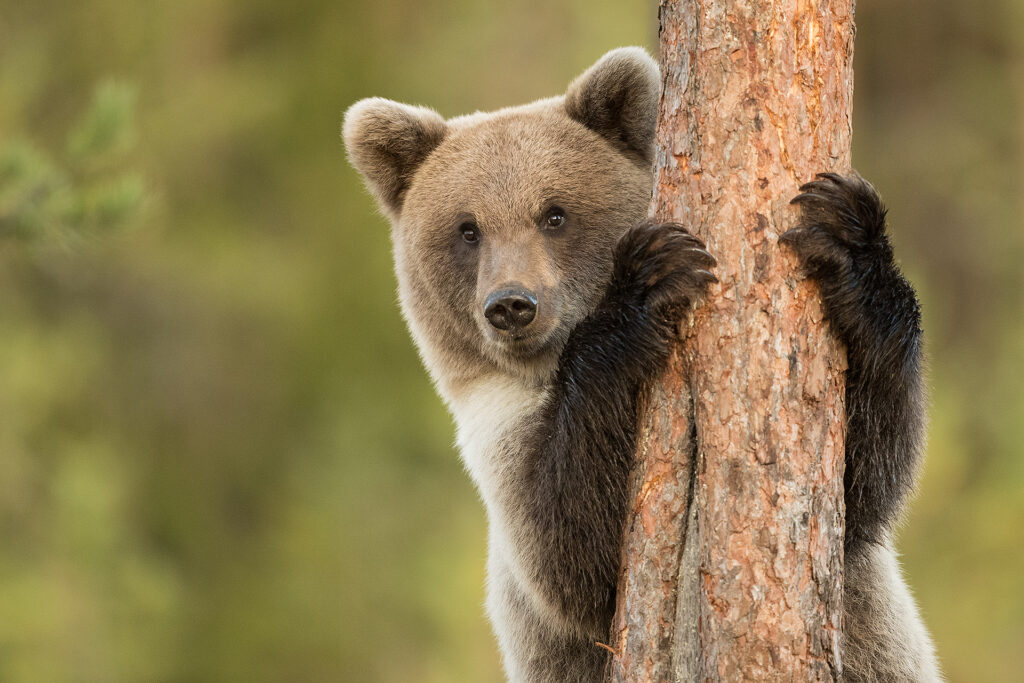
Current estimates suggest Finland supports around 2,000–2,500 Brown Bears, although annual numbers naturally fluctuate with births, mortality and movements across the long eastern border with Russia.
Major concentrations occur in Kuhmo, Kainuu, North Karelia, Northern Savonia and eastern Lapland. Many individuals move between Finland and neighbouring Russia, so maintaining ecological connectivity is essential for healthy genetic diversity.
Brown Bears influence Finland’s forests in several ways. They disperse seeds through berry consumption, recycle nutrients by scavenging carrion and affect the behaviour and feeding opportunities of other wildlife.
Wolves, Wolverines, Ravens and Moose all share the same landscapes. Bears may displace Wolves from carcasses, while Wolverines and Ravens can benefit from food remains or feeding activity created by bears.
More than a century ago, persecution and habitat loss had made Brown Bears increasingly scarce across much of Europe, including Finland. Improved legal protection, scientific wildlife management and growing public appreciation have allowed populations to recover.
Today Finland represents one of Europe’s important large-carnivore conservation success stories. Continued habitat protection, ecological connectivity and responsible wildlife management remain essential.
Brown Bears are often portrayed either as dangerous monsters or as harmless symbols of wilderness. Neither extreme is useful. They are powerful wild animals that generally avoid people, while their ecological role and long history alongside Finnish culture deserve respect.
Brown Bear activity rises sharply as berries ripen and bears enter hyperphagia ahead of winter.
No. Finland’s Brown Bear population is currently considered stable and forms part of one of Europe’s healthiest large-carnivore populations, although continued conservation and responsible management remain essential.
Current estimates generally range between 2,000 and 2,500 individuals, with numbers varying slightly from year to year.
Most cubs are born during January and early February while their mother remains inside her winter den.
Typically one to three cubs, although litters of four occasionally occur.
For much of the year, berries are among the most important foods, supplemented by vegetation, insects, roots, carrion and other seasonal foods.
Young cubs are excellent climbers. Large adults rarely climb significant heights because of their size and weight.
Yes. Activity varies by season, food availability and human disturbance, with evening and early morning often important periods.
Very much so. They show strong spatial memory, problem-solving ability, learning and adaptation, and can remember productive seasonal food sources.
The watching season generally runs from April to October. Late summer and autumn often provide excellent activity, feeding and photography opportunities.
Remain calm, do not run, speak calmly, slowly back away, never approach cubs and give the bear an obvious escape route.
Canis lupus
Powerful, social and elusive — one of Finland’s most fascinating large carnivores.
20–50 kg
Pack life year-7
Gulo gulo · Ahma
The least familiar of Finland’s four large carnivores — stocky, powerful and secretive.
8–28 kg
Mostly solitary
Lynx lynx · Ilves
Finland’s only wild cat and Europe’s largest — an ambush hunter that leaves little trace.
15–30 kg
Mostly solitary

Our weekly Newsletter highlights new adventures, exclusive offers, webinars, nature news, travel ideas, photography tips and more. Sign up today!
Get latest travel deals, inspiration, and exclusive offers delivered directly.
Error: Contact form not found.