


Wildlife photography hides change the equation compared with photographing animals from a vehicle or while walking. You are concealed in one position, and the animal decides where it goes.
A Brown Bear might approach close enough that a 500mm lens becomes too tight. A Wolf might remain further away and benefit from 500mm or 600mm. A Wolverine can change distance rapidly, while an Eagle in flight may require a much wider field of view than a perched bird. This is why focal-length flexibility can be particularly valuable.
Finnish hide operators commonly recommend a broad range of focal lengths because distances vary between hides and throughout a session. Brown Bear hides can accommodate anything from shorter environmental lenses through to long telephotos, while Wolf and Wolverine hides similarly benefit from having options across different focal lengths.
For a photographer who wants one highly versatile wildlife lens for Finland, a 100–500mm-class zoom is one of the strongest options. The greatest advantage is flexibility.
At the shorter end, you can photograph a Bear within its environment, include reflections or capture more than one animal in the frame.
At the longer end, you have enough reach for tighter portraits and more distant wildlife. This is particularly valuable inside a hide because you cannot simply move backwards when an animal approaches.
A 100–500mm lens can therefore cover a remarkably wide range of situations without requiring a lens change. Modern examples include Canon’s RF 100–500mm and comparable long-range zooms from other systems. Independent testing also highlights the versatility of the Canon 100–500mm for wildlife situations where a very long prime can sometimes be too restrictive.
For photographers travelling light, this type of lens is arguably the best place to start.
A 100 400mm lens remains one of the most useful focal ranges for wildlife photography. It offers enough reach for many larger animals while retaining a genuinely useful wide end.
This matters particularly when wildlife approaches close.
A Brown Bear filling the frame at 500mm may leave you unable to capture the whole animal. At 100mm, you have far more room to create an environmental composition. The 100–400mm range is also usually lighter and easier to handle than a large professional
super-telephoto prime.
For photographers who will combine hide photography with general travel, landscapes and walking, it can be an exceptionally practical choice.
Long-range zooms such as 200–600mm occupy an interesting middle ground. They offer significantly more reach than a 100–400mm while retaining the flexibility of a zoom. For Wolves, Eagles and more distant wildlife, that additional reach can be extremely useful. The disadvantage is that 200mm can still be too long when a large animal approaches very close. This is why a 200–600mm can be an excellent second lens or specialist choice, but it may be less universally flexible than a 100 500mm. For photographers travelling with two camera bodies, pairing a 200–600mm with a shorter zoom can provide a very powerful combination.
A 300mm prime can be an excellent focal length for Finland, particularly when you want a combination of reach, subject separation and a relatively manageable field of view. It can work particularly well for larger birds, Wolves at moderate distances and environmental mammal portraits.
A fast 300mm can also be valuable in low light because wider apertures allow more light to reach the sensor. The downside is fixed focal length. Inside a hide, you cannot simply move backwards if an animal approaches, so a prime requires more anticipation.
For experienced photographers who understand the location and expected distances, however, a 300mm prime can produce beautiful results.
400mm is one of the most useful focal lengths for serious wildlife photography. It offers substantial reach without becoming as restrictive as 500mm or 600mm can sometimes be. A fast 400mm f/2.8 is particularly powerful for Finnish photography because it combines reach with exceptional low-light capability and strong subject isolation. It can be ideal for Wolves, Wolverines and Bears when the photographic distance is moderate, as well as for larger birds. The major disadvantage is cost, size and weight. For photographers who already own a professional 400mm prime, however, it can be an outstanding Finnish wildlife lens.
A 500mm prime is a classic choice for wildlife photographers. It provides substantial reach and can produce beautifully isolated subjects against soft backgrounds. For Wolves and Wolverines that remain further from the hide, 500mm can be particularly effective. It can also produce excellent detail in larger birds. The challenge is close encounters. A Bear approaching within a few metres may become too large for the frame. This is why many experienced photographers use a second body with a shorter lens alongside a 500mm prime. The combination provides both reach and flexibility without requiring lens changes inside the hide.
A 600mm prime is designed for photographers who prioritise reach. It can be exceptionally effective for smaller birds, distant Wolves and detailed portraits of animals that remain further from the hide.
The longer focal length also compresses the background more strongly, helping create very clean compositions. However, 600mm is not necessarily the best single lens for a Finnish photography trip. If a Brown Bear approaches extremely close, the field of view may simply be too narrow. A 600mm therefore works best as part of a wider system rather than as the only lens you bring.
Finland’s light can be beautiful, but it can also be challenging. Wolves and Wolverines may appear around dawn or dusk. Summer evenings can remain bright for a long time, but light levels still eventually fall.
A fast lens such as an f/2.8 or f/4 telephoto provides several advantages. It allows faster shutter speeds in low light. It produces shallower depth of field. It can create smoother backgrounds. And it gives the autofocus system more light to work with. A fast aperture is particularly valuable when photographing dark animals against dark forest backgrounds. The trade-off is size, weight and cost. For many photographers, a slower zoom paired with modern high-ISO performance will be more practical.
Consider a Wolf standing among trees. With a narrow aperture, the surrounding forest may remain relatively defined. With a wider aperture, the background can become beautifully soft, separating the animal from the vegetation. This can be particularly effective in Finland’s forests, where backgrounds can otherwise become visually busy. Fast primes such as 400mm f/2.8 or 500mm f/4 are therefore not simply about collecting more light.
They also provide greater control over the visual character of the image. However, don’t assume that the widest possible aperture is always best. If two Wolves are interacting, or if you want the animal and its surroundings to remain recognisable, stopping down can produce a stronger photograph.
Brown Bears are large animals, and they can sometimes approach surprisingly close to photography hides. For this reason, a 100–400mm or 100–500mm zoom is an excellent all-round choice. A 70–200mm can also be valuable for environmental compositions and very close encounters. For tighter portraits, 300mm and longer lenses become useful. Finnish hide operators specifically note that almost all focal lengths can work for Brown Bear photography because distances vary significantly between hides and feeding locations.
If Brown Bears are your primary subject, I would prioritise flexibility rather than automatically choosing the longest lens available.
Wolverines are particularly well suited to a two-lens approach. A 70–200mm can provide wider images when the animal is close, while 300mm and longer lenses can produce tighter portraits.
Finnature specifically recommends a combination of shorter and longer focal lengths for Wolverine photography and notes that distances can vary according to the hide and photographic setup.
A 100-500mm therefore makes an excellent one-lens solution, while a fast 500mm or 600mm paired with a shorter zoom is a stronger professional setup.
Eagle photography presents a different challenge because the subject may change from a perched bird to a fast-moving bird in flight. For flight photography, 300 500mm can provide a useful balance of reach and field of view.
For tight portraits, longer focal lengths become valuable. Finnature’s Golden Eagle hide guidance notes that 300 500mm works well for flight photography, whilearound 200 400mm can be particularly useful for action with wings spread. Longer lenses are better suited to portraits and fine detail. This is another situation where zoom flexibility can be extremely valuable.
Great Grey Owls can present a mixture of photographic opportunities. A long lens can produce beautiful portraits, but a shorter focal length can be valuable for environmental images showing the Owl within the boreal forest.
Because the species is visually striking and often photographed in woodland settings, background control is particularly important. A 100 500mm zoom can therefore be highly practical, while a fast 400mm or 500mm prime can be excellent when the bird remains further away or light is limited.
Capercaillie photography can involve both close encounters and more distant birds. Specialist hides may place photographers close to the lekking area, meaning extremely long lenses are not always necessary. A combination of approximately 70–200mm and 500mm can provide very different perspectives. Finnature’s Black Grouse photography guidance similarly recommends a broad range of focal lengths because birds can move around the lek and appear at varying distances.The lesson is simple: bird photography hides often reward flexibility.
Capercaillie photography can involve both close encounters and more distant birds. Specialist hides may place photographers close to the lekking area, meaning extremely long lenses are not always necessary. A combination of approximately 70–200mm and 500mm can provide very different perspectives. Finnature’s Black Grouse photography guidance similarly recommends a broad range of focal lengths because birds can move around the lek and appear at varying distances.The lesson is simple: bird photography hides often reward flexibility.
If photography is your main reason for travelling to Finland, two camera bodies can be an excellent investment. A common combination would be:
Camera 1: 500mm or 600mm prime.
Camera 2: 100–500mm or 70–200mm zoom.
The long lens remains ready for distant portraits.
The shorter lens handles close approaches and environmental compositions.
Most importantly, this avoids changing lenses during the hide session.
That matters because several Finnish hide operators explicitly prohibit or discourage lens changes during sessions to avoid disturbing wildlife.
Two bodies therefore provide not only flexibility but also a practical advantage.
A 1.4x teleconverter can be extremely useful when you need additional reach. For example, a 500mm lens becomes approximately 700mm, while a 400mm becomes approximately
560mm. This can be valuable for distant Wolves, Wolverines or birds. The trade-off is reduced light transmission and potentially slower autofocus depending on the lens and camera combination.
Teleconverters are therefore best considered as an additional tool rather than something that should remain permanently attached. In a hide, however, they can be particularly useful because you cannot simply move closer.
Wildlife photographers sometimes become obsessed with reach. In Finnish hides, that can be a mistake. Animals can approach surprisingly close. A 70–200mm or similar lens can produce some of the most interesting images because it allows you to show the animal within its environment. A Brown Bear surrounded by autumn forest. A Wolverine beside a pond. A Wolf moving through snow. These photographs can communicate far more about the destination than another tightly cropped portrait. The shorter lens should therefore be considered an important part of a serious Finnish wildlife kit.
A wide-angle lens is not essential for every hide, but it can produce something very different. If wildlife approaches extremely close, a wide or standard lens can create an environmental image that includes the surrounding habitat. A 24 70mm or similar lens may also be useful for landscape photography, accommodation, behind-the-scenes images and the wider Finland trip.
For specialist overnight hide sessions, some photographers also carry a wide lens for unusual environmental opportunities or northern-light photography where conditions permit. It should be considered an additional creative option rather than a replacement for your telephoto equipment.
The lens is only one part of the equation. Long telephoto lenses need stable support during extended hide sessions. Finnish photography hides commonly use wooden shelves, ground pods or other fixed supports. Photographers may need to bring their own tripod or ball head, depending on the operator. Some hide systems use standard 3/8-inch mounting points. A low-profile support such as a beanbag can also be extremely practical. Before travelling, always check what the specific hide provides.
There is little point carrying a large tripod if the hide has a fixed shooting shelf designed for a separate camera head.
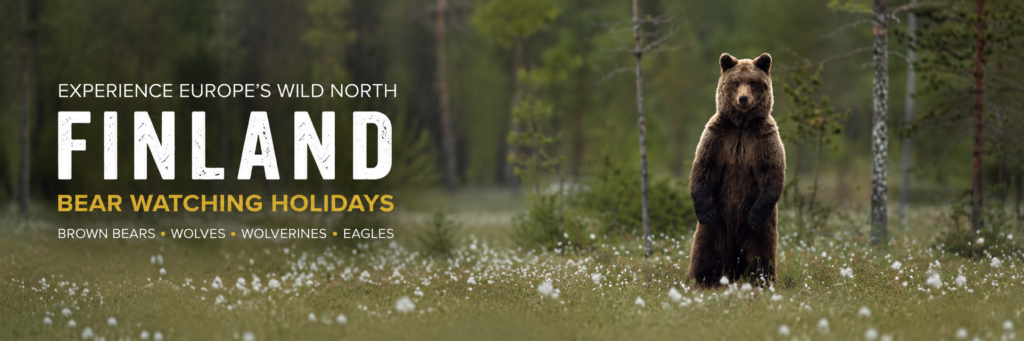
At Natures Thrill, we’ve spent years guiding small groups through some of Finland’s most pristine boreal forest landscapes.
Whether you’re joining us to photograph brown bears, wolves and wolverines, searching for playful bear cubs during our Summer Bear Special, or exploring the spectacular colours of autumn, every itinerary has one thing in common: you’re immersed in one of the cleanest and most beautiful natural environments on Earth.
Along the way, you’ll discover that Finland’s wildlife is only part of the story—the forests themselves are every bit as extraordinary.
If I wanted maximum flexibility from a single lens, I would choose a 100–500mm-class zoom.
It covers close encounters, environmental images and distant portraits without requiring a lens change.
If I could take two bodies, I would pair that zoom with a fast 400mm, 500mm or 600mm prime
depending on the species and hide.
For photographers who already own a 500mm f/4, this can be an exceptional Finland setup.
The 500mm provides the reach and beautiful background separation, while the shorter zoom provides
insurance when wildlife approaches too close.
The exact combination, however, should be dictated by the hides and species on your itinerary.
A beginner does not need a £10,000 super-telephoto to photograph Finnish wildlife successfully.
A good 100 400mm or 100 500mm zoom can be an excellent starting point.
The most important things are:
Reliable autofocus.
Good optical quality.
Image stabilisation where appropriate.
Comfortable handling.
Sufficient focal length.
A lens you are confident using.
Photography skill matters more than owning the longest lens.
A well-composed image at 400mm is far more valuable than a poorly composed photograph simply
because it was taken at 600mm.
There are several mistakes photographers can make when choosing equipment for Finland.
Taking only a very long prime.
This can leave you unable to photograph close encounters.
Taking too many lenses.
A hide is a confined environment and excessive equipment becomes difficult to manage.
Ignoring low-light performance.
Wolves and Wolverines can appear during dawn and dusk.
Forgetting the support system.
A large lens becomes tiring and difficult to control during a long session without proper support.
Changing lenses unnecessarily.
Movement and noise can disturb wildlife, and some hide operators prohibit lens changes.
Choosing focal length based purely on specifications.
The best lens is the one that works with the actual photographic position.
For a single-lens traveller:
100–500mm zoom.
For a versatile two-body setup:
100–500mm + 500mm f/4.
For maximum reach:
100–500mm + 600mm prime.
For a lightweight setup:
100–400mm + 70–200mm.
For a bird-focused trip:
300–500mm + 600mm or teleconverter.
For environmental wildlife photography:
70–200mm + 100–500mm.
There is no universal answer. Your itinerary should determine the equipment.
Best all-rounder: 100–500mm zoom.
Best flexible alternative: 100–400mm.
Best for distant Wolves: 500mm or 600mm prime.
Best professional low-light option: 400mm f/2.8 or 500mm f/4.
Best close/environmental lens: 70–200mm.
Best for mixed wildlife and birds: 100–500mm or 200–600mm.
Best two-lens combination: 100–500mm + fast 500mm or 600mm prime.
Best beginner option: 100–400mm.
Best advice: do not choose your lens solely on maximum focal length.
The best lens for wildlife photography in Finland is not necessarily the longest, fastest or most expensive lens in your camera bag. It is the lens that gives you the ability to respond to what the wildlife actually does. Finnish photography hides can bring animals surprisingly close. They can also leave them further away. Light can change from bright afternoon conditions to extremely low evening illumination, and a session may produce everything from static portraits to fast action.
For most photographers, a versatile 100–400mm or 100–500mm zoom is the safest starting point. For professionals and experienced wildlife photographers, a fast 400mm, 500mm or 600mm prime paired with a shorter zoom can provide exceptional results. Above all, think about focal-length flexibility, low-light performance and the photographic environment. The best equipment is the equipment that allows you to make the photograph when the moment finally arrives.

Our weekly Newsletter highlights new adventures, exclusive offers, webinars, nature news, travel ideas, photography tips and more. Sign up today!
Get latest travel deals, inspiration, and exclusive offers delivered directly.
Error: Contact form not found.