


Finland is one of Europe’s most rewarding destinations for Brown Bear photography. Across the remote forests and wetlands of eastern Finland, specialist wildlife photography hides provide photographers with opportunities to photograph wild Brown Bears in remarkably intimate surroundings.
For wildlife photographers, however, the attraction is about much more than simply getting close to a Bear. Finland offers a constantly changing photographic environment: spring snow, flowering wetlands, deep green summer forests, misty lakes and the rich colours of autumn can all produce completely different images.
Combined with exceptionally long summer evenings and purpose-built photography hides, this makes Brown Bear photography in Finland a particularly rewarding experience for photographers looking to capture both intimate portraits and atmospheric environmental images.
The earliest part of the season can provide some of the most atmospheric images.
Bears emerge from hibernation during spring, and in eastern Finland there can still be snow on the
ground. This creates a striking contrast between the dark Bear and the pale winter landscape.
For photographers who love minimalist images and dramatic environmental conditions, this can be an excellent time to visit.
Learn more about our April bear-watching tour departures by clicking here.
As spring develops, the landscape begins to turn green and Bear activity increases.
May can also provide opportunities for behavioural photography, including interactions between Bears.
The forest floor begins changing rapidly, creating a transition between the winter landscape and the lush conditions of summer.
June is one of the most exciting months for photography.
Finland’s days become exceptionally long, and around midsummer there can be enough natural light to photograph throughout much of the night. The landscape becomes increasingly green, while flowering vegetation can provide beautiful foregrounds and backgrounds.
For photographers, this creates opportunities that simply aren’t possible in most destinations. You can photograph a Bear late at night without relying on artificial lighting or extremely high ISO settings.
July continues to offer exceptionally long photographic days.
The forests are lush, the vegetation is dense and Bears can be photographed against a rich summer landscape.
This is also a good period for photographers interested in more than simple portraits. Environmental compositions can incorporate trees, grasses, ponds and surrounding vegetation into the frame.
Learn more about our July bear-watching tour departures by clicking here.
By August, the nights gradually begin becoming darker, although there remains plenty of useful photographic light.
Some locations can provide opportunities to photograph females with cubs and yearlings. However, cub sightings are never something that should be treated as guaranteed — they depend on natural Bear behaviour and the particular location.
Autumn transforms the photographic possibilities.
Finland’s forests begin taking on their famous autumn colours, providing golden and orange
backgrounds for Bear photography. Bears are also preparing for winter and feeding heavily, which can influence their behaviour and the length of time they remain around photographic sites.
For photographers who prioritise colour, atmosphere and environmental compositions, autumn can be one of the most rewarding periods.
Learn more about our autumn bear-watching tour departures by clicking here.
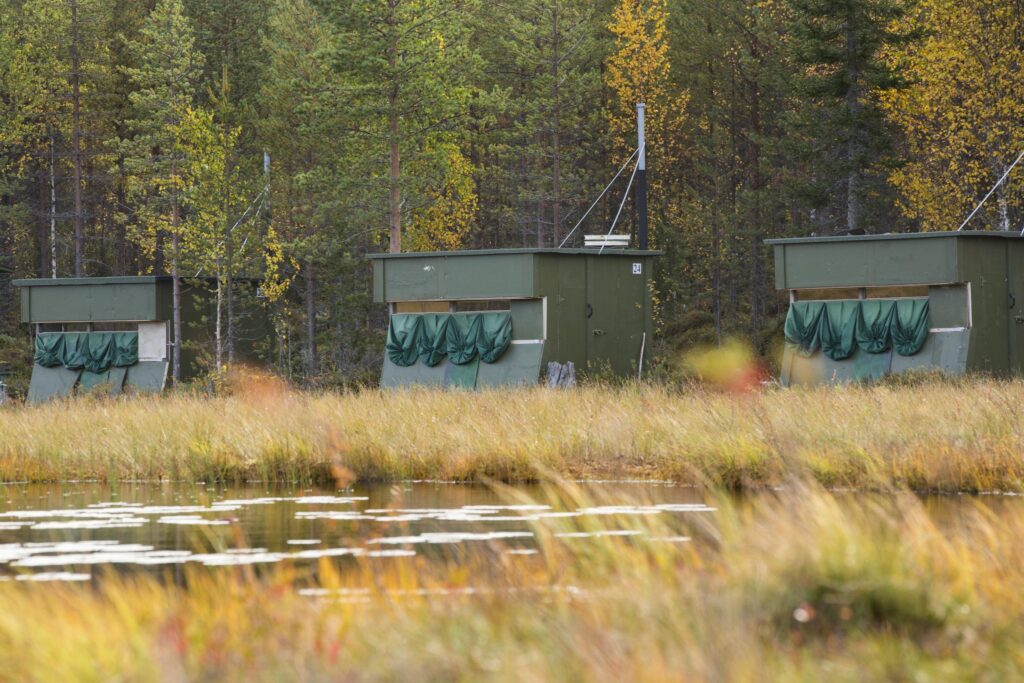
The hide itself can have a surprisingly large influence on your photographs.
Different locations provide different environments.
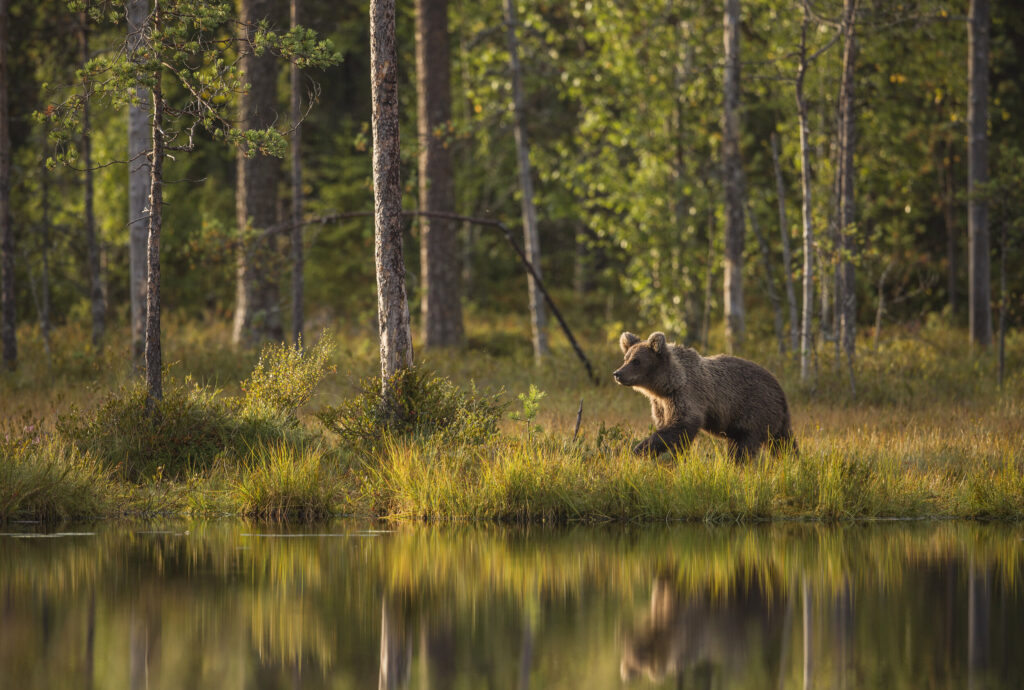
Some hides are positioned within woodland, while others overlook open bogs, ponds or lakes. Some are particularly suited to cub photography, while others provide wider views or opportunities for reflections and swimming Bears.
Forest hides can provide intimate photographs with darker, natural backgrounds. Wetland and bog locations provide more space around the animal and can be particularly attractive for environmental photography. Lakeside positions may offer swimming Bears, reflections, mist and wider landscape compositions.
The best hide is therefore not simply the one that gets you closest to an animal. It is the one that offers the right combination of subject, background, light, angle and habitat.
There is no single perfect lens.
A 70–200mm can be extremely useful for wider environmental compositions and when Bears approach close to the hide.
A 100–400mm or 100–500mm provides considerably more flexibility and would be an excellent
all-round choice for many photographers.
A 300mm, 400mm or 500mm prime can provide beautiful subject isolation and detailed portraits where the distance allows.
However, very long lenses can sometimes become restrictive. If a Bear walks close to the hide, a 500mm or 600mm lens may simply be too tight. For that reason, if taking one lens specifically for a Finnish Brown Bear photography trip, versatility is often more useful than maximum focal length.
A second body with a shorter lens can also be extremely useful, allowing you to change perspectives without changing lenses inside the hide.
Brown Bears can move surprisingly quickly, particularly when interacting with another Bear, climbing or running.
A sensible starting point for general photography might be:
These are starting points rather than fixed rules.
Finnish light can change dramatically during a hide session. A Bear emerging from a dark forest
requires a very different exposure from one standing in open evening sunlight.
The most important thing is to be comfortable adjusting your settings before the action begins.
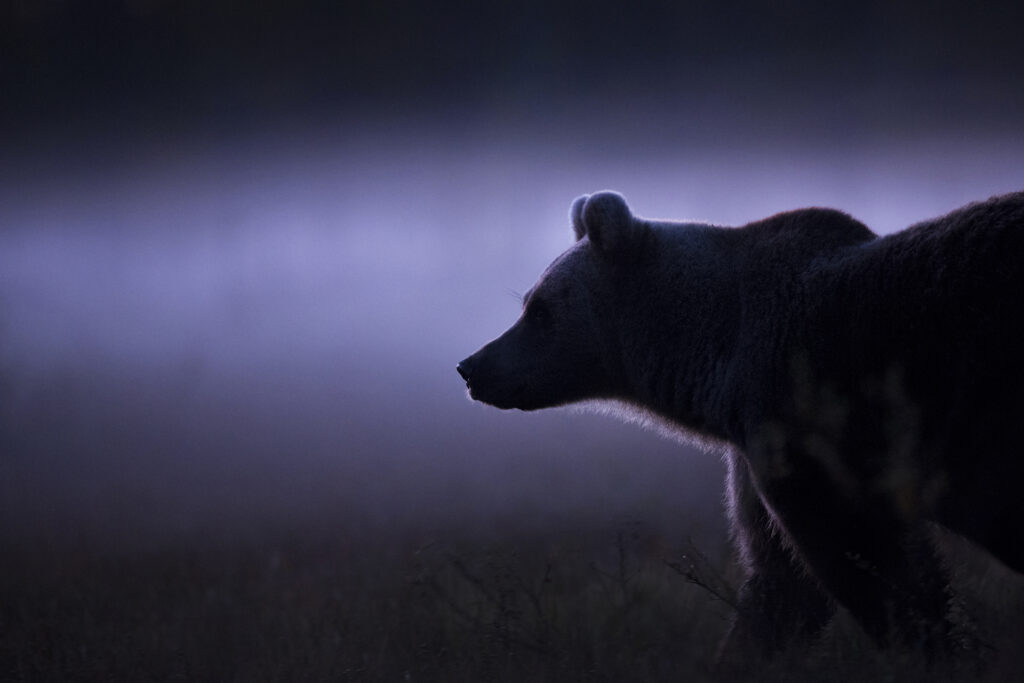
Some of the most beautiful Bear photographs can occur when the light is at its weakest.
Early morning and evening can produce soft directional illumination, while summer nights in Finland can remain surprisingly bright.
This is where fast lenses become particularly valuable.
An f2.8 or f4 telephoto can allow you to maintain useful shutter speeds as the light falls.
Don’t be afraid of higher ISO either. A sharp photograph with some noise is almost always preferable to a beautifully clean but motion-blurred photograph.
Modern cameras are remarkably capable at high ISO, and the priority should generally be shutter
speed, then aperture, then ISO, rather than trying to keep ISO as low as possible.
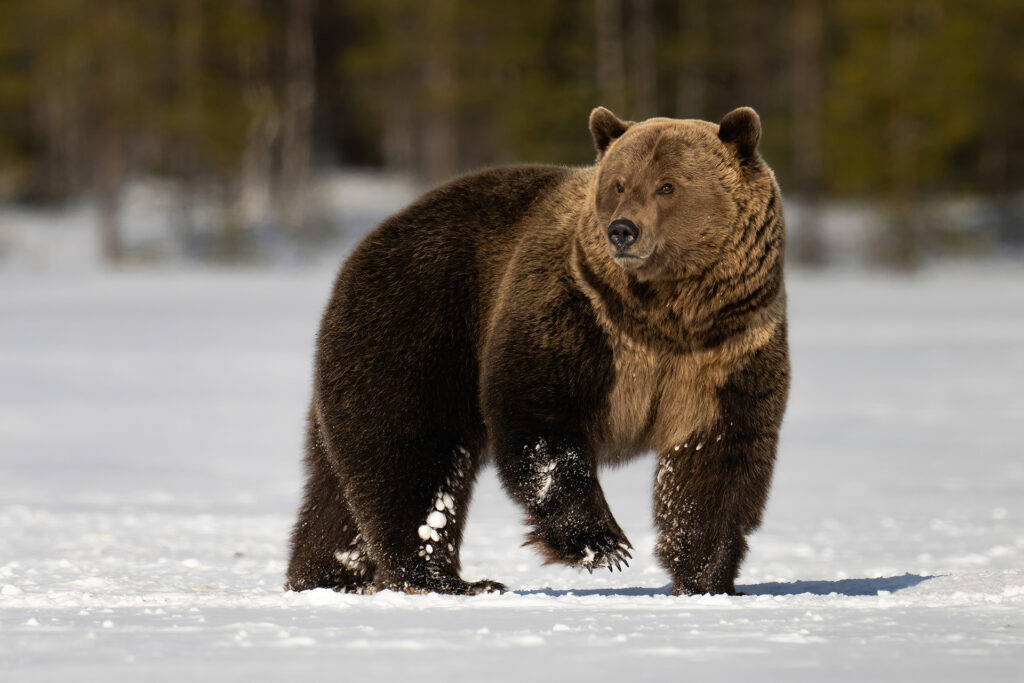
Snow offers one of the simplest and most powerful backgrounds for Bear photography.
A dark Brown Bear against untouched snow can create a striking minimalist composition.
However, snow can easily fool your camera’s metering system into underexposing the image.
Keep an eye on your histogram and highlights, and don’t be afraid to add positive exposure
compensation where necessary.
The goal is to retain detail in the snow without losing texture in the Bear’s dark fur.
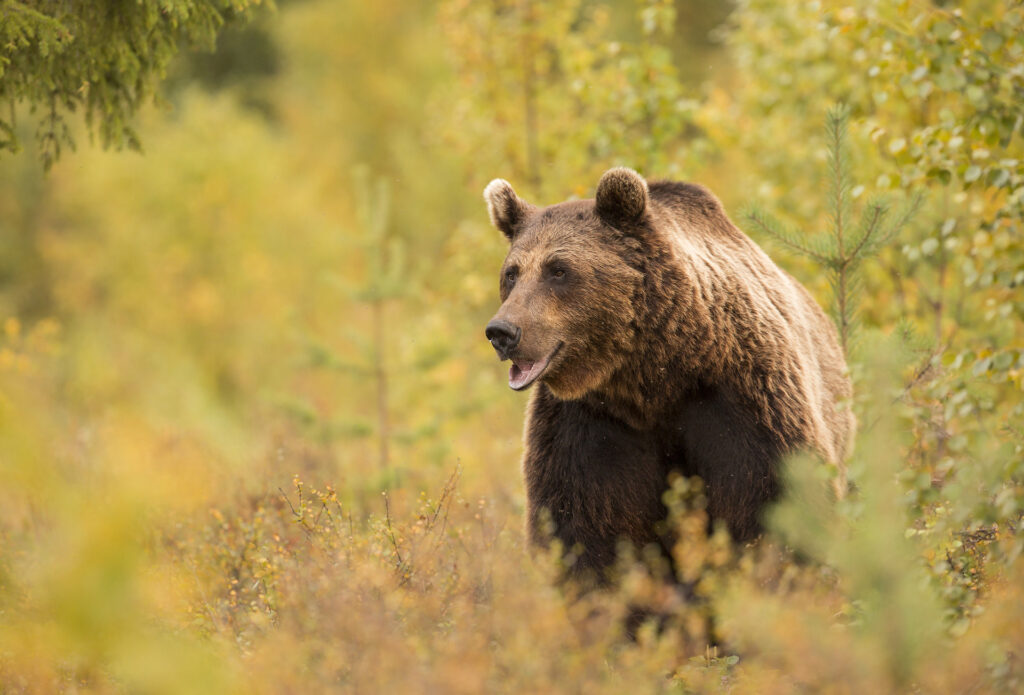
Autumn provides a completely different visual language.
Rather than isolating the Bear against a neutral background, look for opportunities to use the surrounding colours.
Try shooting through foreground foliage, using golden leaves as a background, incorporating
reflections, photographing the Bear walking through vegetation, using wider focal lengths and waiting for the Bear to enter a patch of particularly good light.
This is the season where environmental photography can really shine.
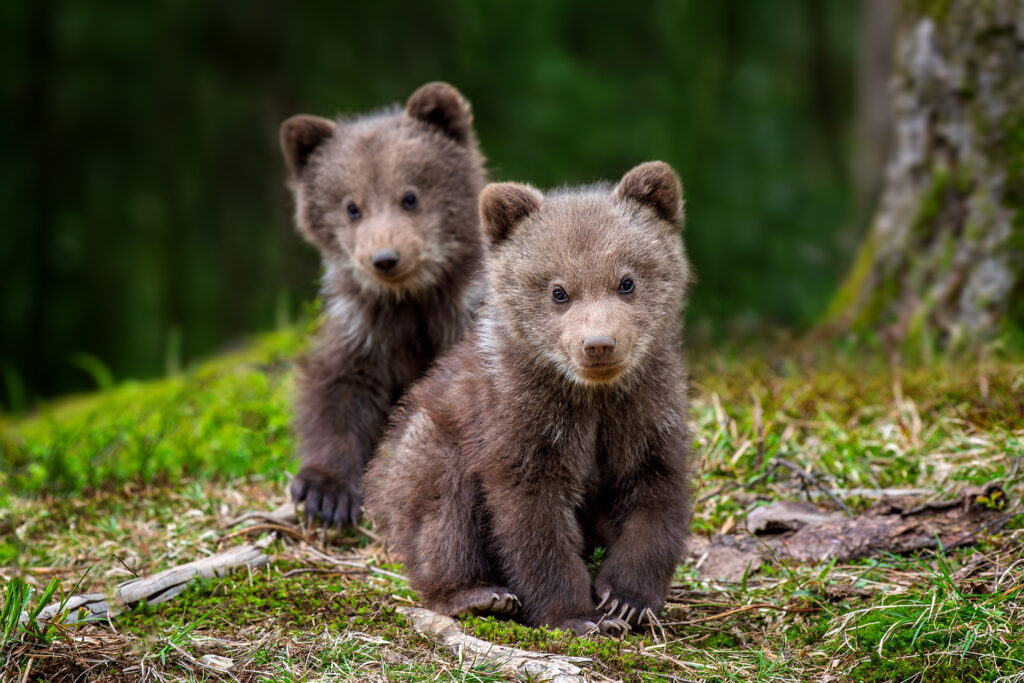
Few wildlife subjects are more appealing than Brown Bear cubs.
However, photographing cubs requires particular patience and an understanding that sightings are never guaranteed.
Cubs are vulnerable, and mother Bears can be extremely protective. Their behaviour can also be less predictable than that of adult Bears.
The strongest photographs often aren’t simply portraits of a cub.
Look for cubs following their mother, climbing behaviour, play, interactions between siblings, movement through vegetation and the relationship between mother and cub.
The story becomes more important than simply getting a cute photograph.
One of the easiest mistakes in wildlife photography is spending an entire session photographing the animal at maximum focal length.
Try deliberately changing your approach.
Shoot wide and show the Bear within the Finnish wilderness. Shoot vertical and use trees, vegetation and reflections to create a stronger composition. Look for layers, watch the background and photograph behaviour.
There is an important distinction between a Bear-watching hide and a photography hide. A viewing hide may prioritise comfort and observation. A photography hide is designed around the needs of photographers, with considerations such as shooting openings, camera support, photographer positioning, low shooting angles, backgrounds and space for equipment. If photography is your primary objective, it is worth confirming that you are booking a dedicated photography hide rather than a general wildlife-viewing experience.
The fact that Bears are photographed from hides does not make them domesticated or tame. They remain wild animals. Photography should therefore always be conducted with respect for the animal and the rules of the hide operator. The photographer’s responsibility is simple: the photograph should never come before the welfare of the wildlife. Follow instructions from guides and hide operators, remain quiet, don’t attempt to attract an animal’s attention for a photograph and never interfere with natural behaviour. The objective isn’t to control the encounter. It is to be present when the wilderness provides one.
Brown Bears are Finland’s most iconic large mammal and one of the country’s most sought-after wildlife photography subjects.
Eastern Finland, particularly the remote borderlands, provides some of the country’s best opportunities. The combination of extensive forests, wetlands and low human population density creates an environment where Bears can move through large areas of wilderness.
Specialist photography hides are positioned at carefully selected locations where wild Bears regularly visit. These can include forest clearings, ponds, wetlands and lakesides, each providing a very different photographic perspective.
This variety is important. A Brown Bear photographed against a dark forest background can look completely different from one standing in a flowering bog, swimming across a lake or silhouetted against the evening sky.
For that reason, choosing the right location and hide can be just as important as choosing your camera and lens.
One of the biggest differences between photographing Bears in Finland and photographing large mammals on safari is the way the encounter takes place.
Rather than following an animal in a vehicle, photographers generally spend extended periods inside a dedicated photography hide.
You might enter the hide during the afternoon and remain there until the following morning, depending on the location and season. Some specialist hides are designed specifically for overnight photography.
The Bear remains wild. The photographer waits. And that waiting is an important part of the experience.
You may spend several hours watching birds, listening to the forest and waiting for something to happen. Then a Bear can suddenly emerge from the trees and walk into the photographic area. The anticipation is a huge part of what makes hide photography so addictive.
Brown Bears are generally photographed in Finland from spring through autumn, after they emerge from winter hibernation. The precise photographic opportunities change considerably throughout the season.
There isn’t one universally best month. Instead, different periods offer different photographic possibilities.
The exact distance varies significantly between photography sites and individual hides.
The important point is that close doesn’t necessarily mean better.
A Bear filling the entire frame can produce an impressive portrait, but a photograph showing the animal within its Finnish environment can often tell a stronger story.
Consider the background, direction of light, water, opportunities for low-angle images, hide design, shooting openings, photographer numbers and which focal lengths are practical from the position.
The goal is not simply to get the longest lens possible. It is to create the strongest photograph possible.
Brown Bear photography hides can occasionally produce opportunities for other wildlife.
Depending on the location, photographers may encounter Wolves, Wolverines, White-tailed Eagles, Golden Eagles, Black Kites, Gulls and Crows, among other species.
This is another reason not to spend the entire session staring at the Bear area through a long lens.
Keep listening. Keep watching. And keep your camera ready.
A secondary species appearing unexpectedly can sometimes produce the photograph you remember most from the trip.
A typical overnight session can be a long one.
At some locations, photographers leave their accommodation during the afternoon, walk to the hide and remain there until the following morning. Some hides include basic sleeping facilities, seating and toilet arrangements for the extended stay.
This means you need to be prepared for the practical side of hide photography.
Take spare batteries, plenty of memory cards, food and water, warm clothing, waterproof layers, camera rain protection, a headtorch and any personal essentials you may need.
Most importantly, wear clothing that allows you to remain comfortable and quiet for many hours.
If Brown Bear photography is the primary reason for your trip, I would strongly favour multiple sessions rather than a single night.
Wildlife photography always contains an element of unpredictability.
One session might produce beautiful portraits. Another could produce several Bears together. A third might provide a spectacular sunset, swimming Bear or unusual behaviour.
Multiple nights also give you the opportunity to experience different hides or photographic environments.
For a dedicated photography trip, two or more nights can therefore make much more sense than trying to fit everything into one session.
Brown Bear photography is just one part of Finland’s extraordinary wildlife photography potential. Continue exploring our Finland Photography guides:
Wildlife Photography in Finland Wolf Photography in Finland Wolverine Photography in Finland Wildlife Photography Hides in Finland Best Lenses for Wildlife Photography in Finland Winter Wildlife Photography in Finland Autumn Wildlife Photography in Finland Photographing Wildlife Under the Midnight Sun . For photographers looking to experience Finland’s wildlife through a dedicated photography itinerary, Natures Thrill’s Finland wildlife experiences can combine specialist locations with carefully planned travel and small-group experiences.

Our weekly Newsletter highlights new adventures, exclusive offers, webinars, nature news, travel ideas, photography tips and more. Sign up today!
Get latest travel deals, inspiration, and exclusive offers delivered directly.
Error: Contact form not found.