Wildlife Holidays / Finland
Nature’s Thrill Wildlife * Specialists 30+ years guiding Finland * 9 min read
Finland’s luxury bear cabins are positioned in established brown bear habitat near the eastern border. Experienced local guides understand the landscape and operate the site throughout the active season.
This makes the chance of an encounter genuinely high. It does not turn a wild bear into a scheduled attraction. That distinction is essential. Ethical wildlife watching allows the animal to decide whether, when and how it appears. The empty intervals are not a failure of the experience; they are part of observing a functioning forest on its own terms.
The Bear Centre currently publishes an approximate seasonal probability of 80–95%. It is best understood as an operator’s historical indication across suitable dates, not a personal guarantee for a particular cabin or night. It does not mean:
● a bear will appear at a fixed hour;
● every guest will have the same view;
● the animal will remain for photographs;
● it will approach to a particular distance; or
● a three-night stay mathematically guarantees success.
Wildlife probability is not the same as rolling an identical die each evening. Conditions and animal movements can be related from one night to the next.
Kuhmo and the wider Kainuu region contain extensive boreal forest, wetlands and relatively low human disturbance. Brown bears range across the landscape, and Finland’s eastern borderlands have become internationally known for responsible observation from purpose-built cabins and hides.
The cabin is not placed beside a zoo enclosure. It sits within the living environment used by bears and other species. Local expertise helps identify productive areas, manage guest activity and reduce disturbance.
The operating season runs broadly from April to October. Bear behaviour changes as animals emerge from hibernation, move through spring and summer, and feed intensively before winter.
No month creates certainty. The best date is one that fits both seasonal wildlife patterns and the
landscape you hope to experience.
Berries, plants and other food sources influence where bears spend time. A strong natural crop elsewhere can alter local movement. This is one reason wildlife behaves differently from year to year.
Temperature, wind and heavy rain may influence activity and visibility. Weather also affects what guests can see through the windows, especially in mist or driving rain.
Brown bears are individuals. Age, sex, breeding behaviour and relationships with other bears all affect movement. A cautious animal may remain at the forest edge while a more confident bear crosses the open ground.
Guests must follow the briefing, remain inside during wildlife hours and minimise noise and light. The cabin is comfortable, but it is still an observatory. Moving furniture, knocking equipment against glass or illuminating the room can reduce the quality of the encounter.
Every additional night creates another observation period. It also allows you to become better at noticing subtle movement and reading the landscape.
Even with excellent habitat, experienced operators and suitable conditions, chance remains. It is the element that keeps a wild sighting meaningful.
The local team recommends a two-night stay. This is sound advice for three reasons.
First, it reduces emotional pressure. On a single night, every quiet minute can feel like time running out. With a second session ahead, it is easier to enjoy the forest as a whole.
Second, conditions can change. Light, weather and wildlife routes may differ significantly on consecutive nights.
Third, your own observation improves. After the first evening, you understand the cabin, window angles and likely lines of approach. The second session often feels more relaxed and attentive.
Two nights still do not guarantee a bear, but they create a better-designed wildlife holiday
You may still see wolverines, foxes, ravens and other forest wildlife, although these are also never guaranteed. You will experience hours in a remote northern landscape and learn how anticipation changes the way you notice sound and movement.
It is reasonable to feel disappointed if bears were your central hope. A reputable specialist should prepare you honestly rather than dismiss that feeling or promise an outcome it cannot control.
Before booking, check the cancellation and amendment terms. A no-sighting night is normally part of the natural risk of wildlife travel, not grounds for a refund.
Bears may sometimes pass within a few metres of a cabin, while at other times they remain much farther away or at the edge of the trees. Distance cannot be predicted.
Do not equate closeness with quality. A bear moving naturally across the wider landscape can reveal more behaviour than a brief close pass. Large windows are designed to provide a broad view, not to manufacture a face-to-face encounter.
Kyle has worked extensively with brown bears across Finland for the past decade and has successfully guided hundreds of nature enthusiasts of all ages and nationalities through the country’s diverse Nordic seasons. His knowledge of the best locations for bear photography throughout Finland is second to none.
Having grown up in Norway, Roger developed a lifelong appreciation for bears. For over 30 years, he has dedicated his career to photographing bears in Finland and is widely recognised for his work with these remarkable animals. His images have appeared in numerous European publications, and he has collaborated with broadcasters including the BBC on the acclaimed series Wild Scandinavia. In 2024, he published two books: The Bear – the Strongest in the Country and The Wolf – the Smartest in the Forest.
The most important actions are about readiness and low disturbance, not manipulating the animal.
No. These are completely wild brown bears. The reported probability is high, but every sighting depends on natural movement.
The Bear Centre currently estimates approximately 80–95%, depending on the season. Statistics may change, so check the latest information when booking.
There is no fixed arrival time. Wildlife can appear during the evening or night observation period, and timing varies.
One night can produce an exceptional sighting, but two nights create more opportunity and are recommended by the local operator.
Females with cubs may be present in the wider population, but no age, sex or family group can be promised.
No. Guests must remain inside during the designated wildlife period and follow local safety instructions.
Wildlife sightings are normally not guaranteed. Review the written booking terms for the exact policy applying to your holiday.
No. These are completely wild brown bears. The reported probability is high, but every sighting depends on natural movement.
The Bear Centre currently estimates approximately 80–95%, depending on the season. Statistics may change, so check the latest information when booking.
There is no fixed arrival time. Wildlife can appear during the evening or night observation period, and timing varies.
One night can produce an exceptional sighting, but two nights create more opportunity and are recommended by the local operator.
Females with cubs may be present in the wider population, but no age, sex or family group can be promised.
No. Guests must remain inside during the designated wildlife period and follow local safety instructions.
Wildlife sightings are normally not guaranteed. Review the written booking terms for the exact policy applying to your holiday.
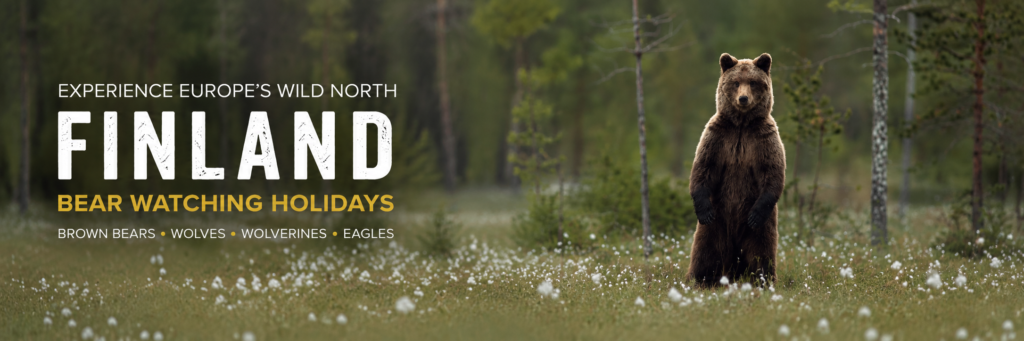
Finland’s luxury cabins offer a high-probability opportunity in genuine brown bear habitat. Natures Thrill can help you choose a suitable season, decide how many nights to stay and arrive with expectations that protect both the experience and the wildlife.