


Have you ever watched a brown bear deliberately walk towards a tree, stand upright and begin rubbing its back against the bark? At first glance, it almost looks as though the bear is simply scratching an itch. In reality, this seemingly simple behaviour plays a vital role in how bears communicate, establish their presence and navigate life within the forests of Finland.
As wildlife guides, it’s one of the behaviours we’re most frequently asked about during our Finland bear watching holidays. Guests often assume the bear has fleas or is scratching an irritating patch of fur. While scratching can occasionally be part of the reason, the truth is far more fascinating. Every tree a bear rubs against tells a story.
It’s a natural message board, carrying information about the individual bear, its size, sex, breeding status and recent movements. Long before another bear comes into view, it may already know who has passed through the area simply by investigating the scent left behind.
Like many mammals, brown bears possess specialised scent glands that produce unique chemical signals, located in several areas of the body including around the head, neck and shoulders. When a bear deliberately rubs against a tree, it isn’t simply relieving an itch — it’s depositing scent. Every rub leaves behind tiny chemical traces that can remain detectable long after the bear has disappeared into the forest.
To another bear, those scents communicate an extraordinary amount of information. Rather than seeing a tree trunk, another bear effectively reads a detailed profile of the individual that visited before. Scientists believe these scent marks may convey information such as:
It’s a sophisticated communication system that allows bears to exchange information without ever meeting face to face.
One of the easiest ways to imagine scent marking is to think of certain trees as communal noticeboards. Not every tree is used. Instead, bears repeatedly choose particular trunks along well-used travel routes, forest tracks or natural corridors.
Over time, these trees become important communication hubs. A bear approaching one of these “message trees” will often slow down, sniff carefully and investigate the scents already present before adding its own. This reduces unnecessary confrontations.
If a smaller male discovers that a particularly large dominant male has recently passed through the area, it may decide to move elsewhere rather than risk a potentially dangerous encounter. Likewise, females can gather information about nearby males during the breeding season without direct interaction. For a largely solitary animal, this form of indirect communication is incredibly efficient.
One of the most important reasons bears scent mark is to advertise their presence. Adult male brown bears are powerful animals, but serious fights carry significant risks — a single injury could make hunting, feeding or surviving the coming winter much more difficult.
Instead of constantly fighting to establish dominance, scent marking allows bears to avoid many confrontations altogether. By leaving their scent — and often claw marks — on prominent trees, dominant males effectively announce: “I’m here.” “I’m large.” “This is part of my regular range.” Other bears receive the message without either animal needing to engage in physical conflict. It’s an elegant solution that conserves energy and reduces the chance of injury.
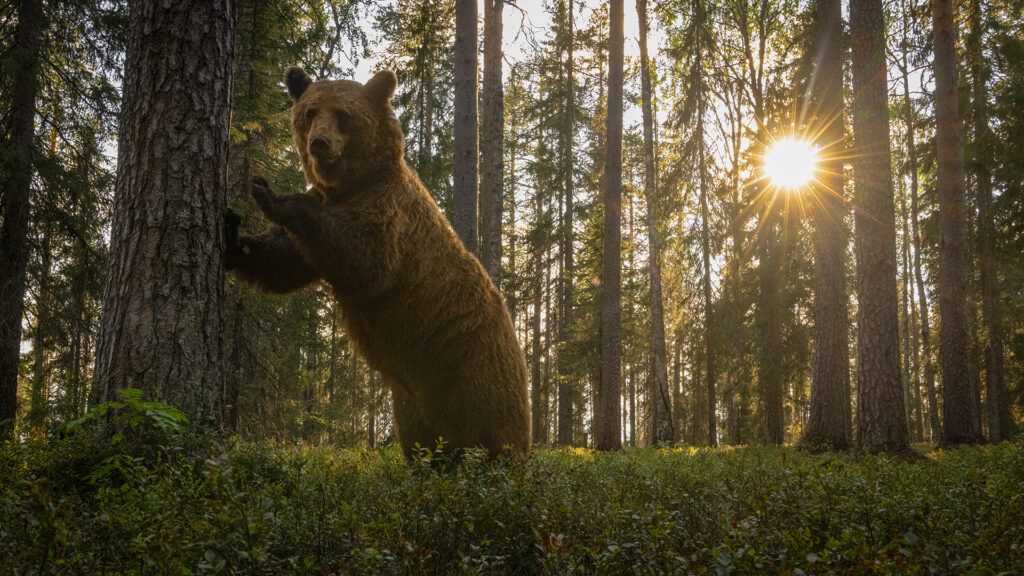
Many visitors become particularly excited when they see a brown bear standing on its hind legs against a tree. To someone unfamiliar with bear behaviour, this can appear intimidating. In reality, it’s usually a perfectly relaxed and natural behaviour.
Standing upright simply allows the bear to reach higher on the tree trunk, deposit scent from glands around the neck and shoulders, leave visible claw marks, and investigate scents left by previous visitors. Larger bears often rub much higher than younger individuals, creating another subtle signal about their size and strength — the height of a scent mark may therefore provide useful information to other bears passing through the area.
If you’ve ever explored Finland’s forests, you may have noticed long vertical scratches running down the bark of certain trees. These aren’t random. Many are made intentionally by brown bears. As bears rub against the trunk, they frequently extend their claws, leaving highly visible marks behind.
These scratches serve two purposes. Firstly, they reinforce the bear’s scent mark by drawing attention to the tree. Secondly, they create a visual indicator of the bear’s size — a particularly tall set of claw marks sends a clear message to any rival that comes along later. Sometimes, simply seeing those marks is enough to persuade a younger male to continue walking.
One fascinating aspect of bear behaviour is that the same rubbing trees may be used repeatedly for years. Generation after generation of bears may visit exactly the same location. Researchers using camera traps have documented individual trees being visited dozens — sometimes hundreds — of times over multiple seasons.
Why? Because the location itself often makes sense. Perhaps it’s beside a well-used game trail. Perhaps it’s close to a natural crossing point. Or perhaps generations of bears have simply reinforced its importance through repeated use. Whatever the reason, these trees become long-standing communication hubs within the forest.
Brown bears rub against trees throughout much of their active season, but the behaviour becomes especially noticeable during late spring and early summer. This coincides with the breeding season, when communication becomes particularly important. Males are searching for receptive females. Females are evaluating potential mates. Rival males are attempting to avoid unnecessary conflict while still establishing their presence.
Although scent marking continues later into summer and autumn, breeding season generally produces the highest levels of activity.
Absolutely — and it’s one of the most rewarding behaviours to witness. While no wildlife behaviour can ever be guaranteed, guests on our Finland bear watching tours occasionally enjoy watching bears stand upright to investigate or rub against nearby trees.
Unlike dramatic interactions between rival males, scent marking often unfolds quietly. A bear approaches the tree with purpose. It pauses. Sniffs carefully. Rises onto its hind legs. Presses its shoulders firmly against the bark before slowly rubbing from side to side. Then, just as calmly as it arrived, it continues on its journey.
To many people, it may seem like a brief moment. But understanding the behaviour transforms it into something far more meaningful. You’re not simply watching a bear scratching. You’re witnessing an ancient form of communication that has shaped bear societies for thousands of years.

From a wildlife photography perspective, tree-rubbing behaviour offers some wonderfully expressive images. A standing bear immediately creates a stronger composition than one feeding with its head down. The upright posture emphasises the animal’s impressive size while adding a sense of movement and character to the photograph.
It’s also one of the best opportunities to capture behaviour rather than simply a portrait. Behavioural images often tell a richer story — and it’s those moments that many photographers treasure most.
Kyle has worked extensively with brown bears across Finland for the past decade and has successfully guided hundreds of nature enthusiasts of all ages and nationalities through the country’s diverse Nordic seasons. His knowledge of the best locations for bear photography throughout Finland is second to none.
Having grown up in Norway, Roger developed a lifelong appreciation for bears. For over 30 years, he has dedicated his career to photographing bears in Finland and is widely recognised for his work with these remarkable animals. His images have appeared in numerous European publications, and he has collaborated with broadcasters including the BBC on the acclaimed series Wild Scandinavia. In 2024, he published two books: The Bear – the Strongest in the Country and The Wolf – the Smartest in the Forest.
Tell Natures Thrill:
That creates a meaningful total rather than a misleading room-only comparison.
Occasionally a bear may scratch an itchy patch of fur, especially during seasonal moulting. However, deliberate rubbing on specific trees is primarily associated with scent marking and communication rather than parasite removal.
Yes. Both males and females scent mark, although adult males generally do so more frequently and more prominently during the breeding season.
Generally, no. Bears possess an extraordinary sense of smell that is many times more powerful than our own, allowing them to detect scent signals that humans simply cannot perceive.
Not every tree, but many bears repeatedly use well-established rubbing trees that have become important communication points within the forest.
If you encounter one while hiking, it’s best to admire it from a respectful distance. These trees are important natural communication sites for wildlife, and leaving them undisturbed helps preserve normal bear behaviour.
The next time you watch a brown bear pause beside a weathered pine and slowly rub its shoulders against the bark, you’ll know you’re witnessing far more than a simple scratch. You’re seeing one of nature’s oldest communication systems in action — invisible messages exchanged between animals that may never meet, a silent conversation written not in words, but in scent.
It’s just one of countless fascinating behaviours that make Finland’s brown bears such extraordinary animals to observe — and one of the many reasons spending time in their world is an experience that never loses its sense of wonder.

Our weekly Newsletter highlights new adventures, exclusive offers, webinars, nature news, travel ideas, photography tips and more. Sign up today!
Get latest travel deals, inspiration, and exclusive offers delivered directly.
Error: Contact form not found.